
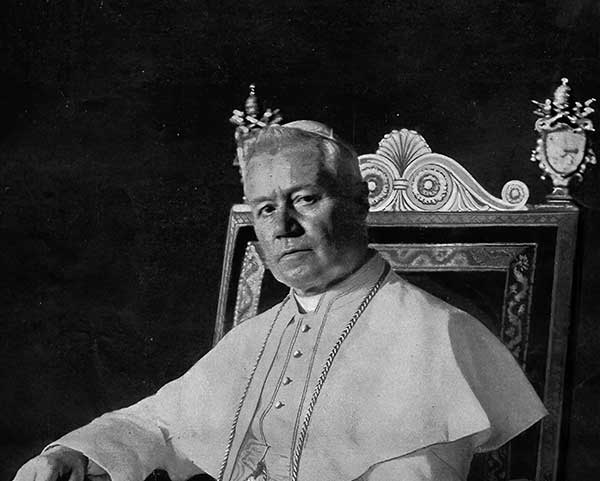
Saint Pius X, in the world Giuseppe Melchiorre Sarto, wrote the following words in his will and testament: “I was born poor, I have lived in poverty, and I wish to die poor”. He was a Pope from a humble social background, who was elected to the See of Peter, after going through all the steps of the ecclesiastical career: Chaplain, Parish Priest, Bishop, Cardinal and Patriarch.
Born in Riese in the Province of Treviso on 2 June 1835, he was the first-born of the 10 children of Giovan Battista Sarto and Margherita Sanson. He felt a vocation to the priesthood, but due to scarce economic resources, his desire remained as such. His dream was fulfilled thanks to Patriarch Jacopo Monico, also from Riese, who gave him a scholarship to the Seminary of Padua. Unfortunately, the early death of his father left the family in poverty and things became complicated. In fact, Giuseppe as head of the family, was responsible for supporting his siblings and his mother Margherita. He never neglected this responsibility over the course of the years and was able to provide them with sustenance. However, we must also consider that it was thanks to his mother’s efforts that he was able to continue his formation at the Seminary. When he had finished his studies, Giuseppe Melchiorre was ordained a priest on 18 September 1858 in the Duomo of Castelfranco Veneto.
His first appointment was as Chaplain in Tombolo, in the Province of Padua, a small country parish. He arrived there on 29 November 1858 and stayed in that position for nine years. In 1867, he achieved the highest score in his exams and was appointed parish priest of Salzano, an important borgo in the Province of Venice, where he remained for some nine years and began to write his Catechism, made of questions and answers, for which he was later known throughout the world.
It was during this period that he joined the Third Order of St Francis and established two fraternities of Tertiaries. Henceforth he strove in his words and in his writings, especially by Franciscan simplicity and frugal standards of life, to emulate the ideals of the seraphic saint.
In September 1884, Leo XIII appointed him Bishop of Mantua. At that time, the diocese was in a particularly difficult situation, both within and in its relations with the civil authorities. The new Bishop, renowned for his eloquence and profound charity, proved to be a skilled mediator, reconciling opposing factions and inspiring a deep renewal of Christian life. He reopened the Seminary, strengthened worker cooperatives, and devoted himself tirelessly to social concerns. Through his dedication and ability, the Diocese of Mantua experienced a true rebirth.
In recognition of his achievements, Pope Leo XIII created him Cardinal on 12 June 1893 and, only days later on 15 June, appointed him Patriarch of Venice. Yet political tensions delayed his entry into the city until 24 November 1894, as the Italian government withheld approval, insisting that the King should decide the appointment. Once resolved, his episcopal ministry again revealed his remarkable gifts and resourcefulness.
His life was marked by radical generosity: he gave all his possessions to the poor, even refusing to commission new cardinal vestments. Instead, he asked his sisters to alter those of his predecessor, donating the money he would have spent to those in need.
Leo XIII passed away on 20 July 1903 and the conclave was called. On 4 August 1903, Giuseppe Melchiorre Sarto was elected Pope, choosing the name Pius X. During his Pontificate, inspired by his motto, Instaurare omnia in Christo (Renewing all things in Christ), he introduced important reforms, such as the restructuring of the Roman Curia and of various Congregations, and the beginning of the Codification of Canon Law, later promulgated by Benedit XV. He was a Pope who was close to the people, promoting their doctrinal formation also through the Catechism, marked by simple and precise language. His decision to lower the age of Communion to seven, “when a child begins to reason”, was very important for Christian formation. He also carried out the reform of the liturgy and in particular, of scared music, rediscovering Gregorian Chants. He disapproved of modernism, in order to protect the faithful from deceptive concepts.
Unfortunately, at the end of his life, World War I broke out when the Austro-Hungarian government declared war on and Serbia on 28 July 1914, one month from the assassination of Archduke Franz Ferdinand and his wife Sophie in Sarajevo. On 2 August, he made a heartfelt appeal for peace. He died on the night between 20 and 21 August 1914.
He was considered a “Saintly Pope” in his lifetime and people recounted stories of healings that had taken place simply by touching his garments. He would answer, “My name is Sarto not Santo” (not Saint). He was beatified on 3 June 1951 by Pius XII and canonized by the same Pope on 29 May 1954.
Liturgical Memorial: August 21
Resources:
https://www.causesanti.va/it/santi-e-beati/elisabetta-isabella-di-portogallo.html
https://franciscansoflife.com/2015/08/22/st-pius-x-our-brother-giuseppe/